
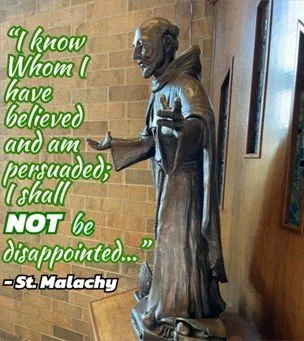
St. Malachy, Our Patron Saint
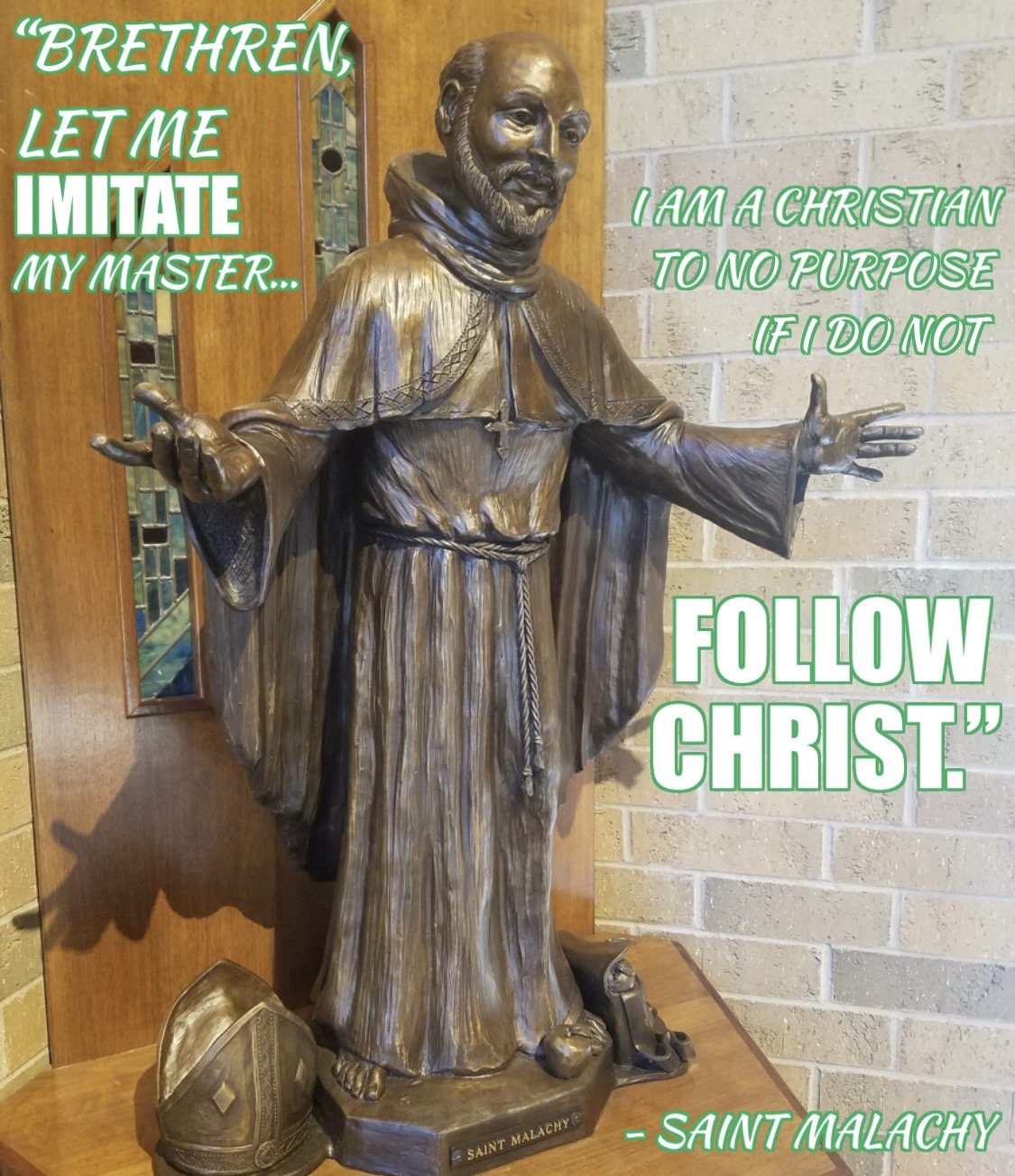
During his life on earth St. Malachy was:
12th-century Ireland's leading reformer of Christianity
a humble man who shunned personal possessions
the first native of Ireland to be canonized a saint by a pope
An abbot, bishop, archbishop and eventually papal legate to all of Ireland
a prophet and worker of miracles
A model of evangelizing a post-Christian culture
SHORT SUMMARY
Saint Malachy leaves us the very relevant example of evangelizing a post-Christian culture, helping a people that has forgotten the Christianity that helped form it to rediscover what they have lost. He was a man through whom the Lord worked to rebuild and restore and this was possible because of how Malachy came to know the Lord’s power to restore. As He did for Ireland in the 12th Century, so we can do for our culture today, with the help of the Lord. Malachy first took up this mission of restoration as Abbot in Bangor. During this time, he became known as a model of holiness and his first miracles occurred. And as Our Lord said, “The person who is trustworthy in very small matters is also trustworthy in great ones,” so this would just be the beginning of Malachy’s mission of restoration. Thus, he was called upon to do it again as bishop in Connor… and then to do it again as Archbishop in the more prominent Diocese in Armagh (his hometown). He always wanted to return to a simpler life, so he entrusted Armagh to another and became bishop of the smaller diocese of Down. But, while journeying to Rome to seek papal approval over all they were doing, he stopped along the way at the Cistercian monastery in Clairvaux, France, where he met Saint Bernard. He loved it so much that he asked the pope if he could simply move to Clairvaux and become a cistercian monk. The pope said no and made him his personal legate over all of Ireland. Malachy’s mission of restoration wasn’t finished and would now benefit all of Ireland. His witness of holiness and virtue would continue to impress many and miracles would abound. He would finally die in Claivaux, during another journey back to Rome, on All Souls Day, precisely as he had predicted. In the book "The Life of Saint Malachy of Armagh," his biographer and friend Saint Bernard of Clairvaux says Malachy was distinguished by his meekness, humility, obedience, modesty and true diligence in his studies. Saint Charles Borromeo praised him for attending to the needy, bringing the holy sacraments to all alike, and renewing the fervor of the people in receiving them. Clearly, Malachy is a shining example for all times.
IRELAND OF THAT TIME
Physically isolated from the continent by the high seas, Ireland was the only European country not overrun by barbarians during the Fall of Rome and the Dark Ages. During those centuries Ireland preserved the literature of Christian civilization; students flocked to her abbeys and monasteries for their education; and for several hundred years she was indeed the island of saints and scholars.
Around the start of the 9th century, however, the Viking raids on Ireland began. The country was subsequently invaded and occupied; many monasteries were plundered; monks were put to the sword; churches demolished; and libraries burned. These disruptions along with secular impositions by the invader produced a decline in observing the religious and moral standards established by Saint Patrick and other early missionaries. Apathy towards the Christian virtues was increasing and by the 11th century some parts of Ireland had even returned to paganism. This was the world into which Malachy was born.
YOUNG MALACHY
Saint Malachy was born in Armagh in 1094 A.D. He was baptized Maolmhaodhog ua Morgair (Malachy O'More). His father, a teacher, died when Malachy was seven. His mother, a pious woman, lived just long enough to bring up her son in the love and fear of God. After her death, desiring to learn the practices of humility and living for God, he submitted himself to the religious discipline of Eimar (Imar O'Hagan), a holy recluse residing in a cell near Armagh cathedral. Saint Bernard says of that experience: "His obedience as a disciple, his love of silence, his fervor in mortification and prayer, were the means and marks of his spiritual progress."
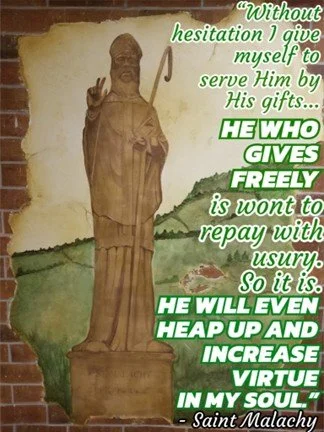
As young Malachy grew in prayer and virtue, He recognized the source of this growth and resolved to give his heart to God, committed his life to His service: “My spirit is of God, and I know the things that are freely given me in it… I have this treasure in an earthen vessel… I must take heed lest it should strike against something and be broken, and the oil of gladness which I carry be poured out… I am His… and what I am and all that I have, where can it be as safe as in the hand of their Author? Who so concerned to preserve, so powerful to hold, so faithful to restore? … Without hesitation I give myself to serve Him by His gifts… He who gives freely is wont to repay with usury. So it is. He will even heap up and increase virtue in my soul.”
Upon completing his training he persuaded Eimar to accept other novices and a hermitage community developed. The Archbishop of Armagh, Ceolloch (Saint Celsus), ordained him a priest at age 25 although the prescribed age was 30. Fearing that he was not sufficiently prepared to carry out the mission which the archbishop was planning for him, Father Malachy went to Lismore where he spent nearly two years studying sacred liturgy and theology under Saint Malchus.
The archbishop sent Malachy out to preach the word of God to the people and to correct many evil practices which had developed over the years. He achieved notable success. To reform the clergy he instituted regulations concerning celibacy and other ecclesiastical discipline, and reinstituted the recitation of the canonical hours. Most importantly, he gave back the sacraments to the common people, sending good priests among them to instruct the ignorant. He returned to Armagh in 1123.
ABBOT AND BISHOP
That year his uncle, lay-abbot at the Abbey of Bangor, resigned the abbey to Malachy in hopes that he might return it to its former status and observance. With ten members of Eimar's community of hermits he rebuilt the abbey and ruled it for a year, during which time several miracles were attributed to him. He also established a seminary for priests there. Malachy was zealous in performing his own monastic duties and set a good example to his priests. But in an act of charity that caused many objections he gave away the abbey's lands and most of its revenues.
Soon after leaving the abbey, Malachy was chosen at age 30 to be Bishop of Connor. He set about converting its nominal Christians to a true devotion, searching them out on foot in their homes and fields to bring them to church. Drawing on his connection with Bangor he was able to staff the churches of the diocese with well-instructed priests who revived the fervor of the people. He renewed all things in Christ. In all his actions he breathed a spirit of patience and meekness.
With the Church starting to gain strength, the local secular princes made trouble. The city of Connor was sacked and Malachy had to flee. He led the Bangor monks to County Kerry, where they were welcomed by King Cormac. They settled in the vicinity of Cork, which is how Malachy came to be venerated there.
RELUCTANT ARCHBISHOP
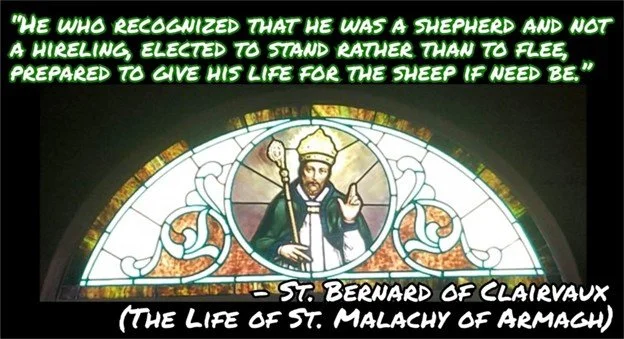
As in England at that time, secular rulers often usurped authority from the Church. In this way the succession of archbishops in Armagh had been made hereditary over the years, and Archbishop Celsus now wished to break the chain by leaving his see to Malachy. In 1129 Celsus died and a few days later Malachy received the archbishop's staff along with a letter from the dying man naming him as the next archbishop of Armagh. When Celsus' relatives heard of this they acted quickly, installed the late archbishop's cousin Murtagh. Malachy refused to try to occupy the the cathedral for three years, fearing further bloodshed by Celsus' kin.
During this time, as Saint Bernard writes, Malachy established Church discipline and replaced the Celtic Liturgy (the "Stowe" Missal) with the Roman Liturgy.
Finally, in 1132, under threat of excommunication if he refused to formally take office, Malachy submitted, saying: "You drag me to death. I obey in the hopes of martyrdom, but on this condition: that if the business succeeds and God frees His heritage from those who are destroying it--all being then completed, and the Church at peace, I may be allowed to go back to my former bride and friend, poverty, and to put another in my place!" In this way Malachy declared that he would stay only long enough to restore order, and he refused to enter the city or the cathedral, ruling from outside.
In 1134 Murtagh died, naming another member of the laity, Nigellus (Niall, who was Celsus' brother) as his successor. To give weight to his claim Niall seized two precious relics from the cathedral, the golden Crozier of Saint Patrick, called the Bachal Isu (Staff of Jesus), and the Book of the Gospels, which had been handed down from the time of Saint Patrick. The common people believed that the true archbishop was the one who had these relics in his possession. Also in support of Niall, the secular rulers refused to recognize the legitimacy of Malachy's claim, instead persecuting him and putting obstacles in his way at every turn. Both sides were supported by militia, armed conflict broke out, and as a result of this struggle Malachy finally took possession of the cathedral.
Malachy's rivals invited him to a meeting, and though aware of their evil designs, he went with a few companions. The results were surprising. His mildness and courage disarmed his enemies and they rose up to do him honor. Peace was concluded between them. Niall was deposed, the relics restored (although Malachy had to purchase the Crozier from Niall), and Malachy finally took unchallenged possession of the see.
In 1138, having broken the tradition of hereditary succession, rescued Armagh from oppression, restored ecclesiastical discipline, re-established Christian morals, and seeing all things tranquil, Malachy resigned his post as originally agreed. He appointed Gelasius of Derry, a worthy prelate, to succeed him as archbishop and returned to Connor, dividing that diocese into the sees of Down and Connor and retaining the former. Living in peace as Bishop of Down, he founded a priory at Downpatrick for the community of Ibracense monks, with whom he resided.
TO ROME AND CLAIRVAUX
Now that more tranquil times blessed the land, Malachy set out for Rome to give an account of the affairs of his diocese to the pope, Innocent II. This was a difficult trip in those days. He traveled via Scotland, England and France, stopping at the Cistercian abbey of Clairvaux to meet Saint Bernard. In Rome he petitioned the pope for official pallia (bishop's cloaks) for the metropolitan See of Armagh and the new diocese of Cashel. While in Rome the pope officially approved all that Malachy had accomplished and appointed him legate (the official representative of the pope) for Ireland.
On his return journey he left some of his companions in Clairvaux to learn the way of life and the rule of the Cistercian monks. (They returned to Ireland in 1142 with five of the monks to establish the Cistercian Order at Mellifont, thus founding the great abbey located there.)
Malachy returned home through Scotland, where he miraculously restored the health of Prince Henry, grandson of Saint Margaret. Malachy told the lad, "Be of good courage; you will not die this time," and sprinkled him with holy water. The next day the dangerously-ill boy recovered.
Arriving in Ireland he was welcomed by the people and priests. As the newly-appointed legate, he convened synods and enforced further regulations for abolishing abuses. Malachy continued to work many miracles for the sick and afflicted.
THE FINAL JOURNEY
Pope Innocent II died before the pallia were sent, and two other popes were elected and died in rapid succession (Celestine II, 1143-44, and Lucius II, 1144-45). Malachy convened a synod of bishops and received their commission to apply once again for the pallia, and he started a journey to visit the new pope, Eugenius III. Approaching the Alps in October, 1148, he fell ill with a fever. He was given hospice by the monks, who with Saint Bernard, treated him as a dear friend. As his fever grew worse, he told them that he would not recover and asked to receive the sacraments. He died in Saint Bernard's arms on November 2 and his body was buried at Clairvaux.
Saint Malachy was canonized in 1190 by Pope Clement III. Although Malachy died on November 2, the Feast of Saint Malachy is observed on November 3 so as not to conflict with All Souls Day. His feast is kept by the Cistercians, the Canons regular of the Lateran, and throughout Ireland.
VIRTUE, MIRACLES AND PROPHECIES
The Lord worked many miracles through Malachy, with many fascinating stories filling the pages of Saint Bernard’s “Life of Saint Malachy of Armagh.” In Ivrea, Italy, he cured his host's child. He exorcised two women in Coleraine, and one in Lismore. In Cork he raised from a sick bed one whom he named bishop of the city, and a notorious scold was cured when she made her first confession to Malachy. In Ulster a sick man was immediately cured by lying on the saint's bed. A sick baby was healed instantly in Leinster. In Saul, County Down, a woman whose madness drove her to tear her limbs with her teeth was cured when he laid hands on her. At Antrim a dying man recovered his speech on receiving the Holy Viaticum. A paralyzed boy was cured in Cashel and another near Munster. On an island where the fishermen were suffering for lack of fish, he knelt by the shore and prayed, and the fish returned. In addition to these, many other miracles occurred at Malachy's tomb. Perhaps most significantly, in Chapter VI, Bernard details 23 stories of miracles from his years a papal legate to Ireland (in addition to various other miracle stories told throughout the book), including healings, exorcisms, miraculous catches of fish and even raising the dead.
But before diving into these stories, Bernard will note, “I confess I had rather dwell on those things which can be imitated than on those which can only excite wonder. And in my judgement, the first and greatest miracle he exhibited was himself… his inner man, the beauty and strength and purity of which his habits and life sufficiently attested.” Thus, he proceeds to write at length first of his virtues: “Everything in him was under discipline, everything a mark of virtue, a rule of perfection… What wonder, then, if he has wrought wondrous things when he himself is so wonderful? Yet truly not he but God in him.”
Malachy is also noted for the gift of prophecy. Saint Bernard tells of Malachy predicting the day and hour of his own death. But the best-known prediction attributed to him is the sequence of future popes, which receives some publicity especially whenever a new pope is about to be elected. However, the history behind this supposed prophecy and its alleged connection to Malachy is dubious to say the least. The most reliable information is that which comes from Saint Bernard.
For more on the inspiration we can draw from Saint Malachy our “Getting to Know Saint Malachy” video playlist can be viewed here: https://youtube.com/playlist?list=PL4WH8P9qN2fXwwVUEeGO5uYZh2gSWoSPW&si=b95JGD0-CF4ZXSV7